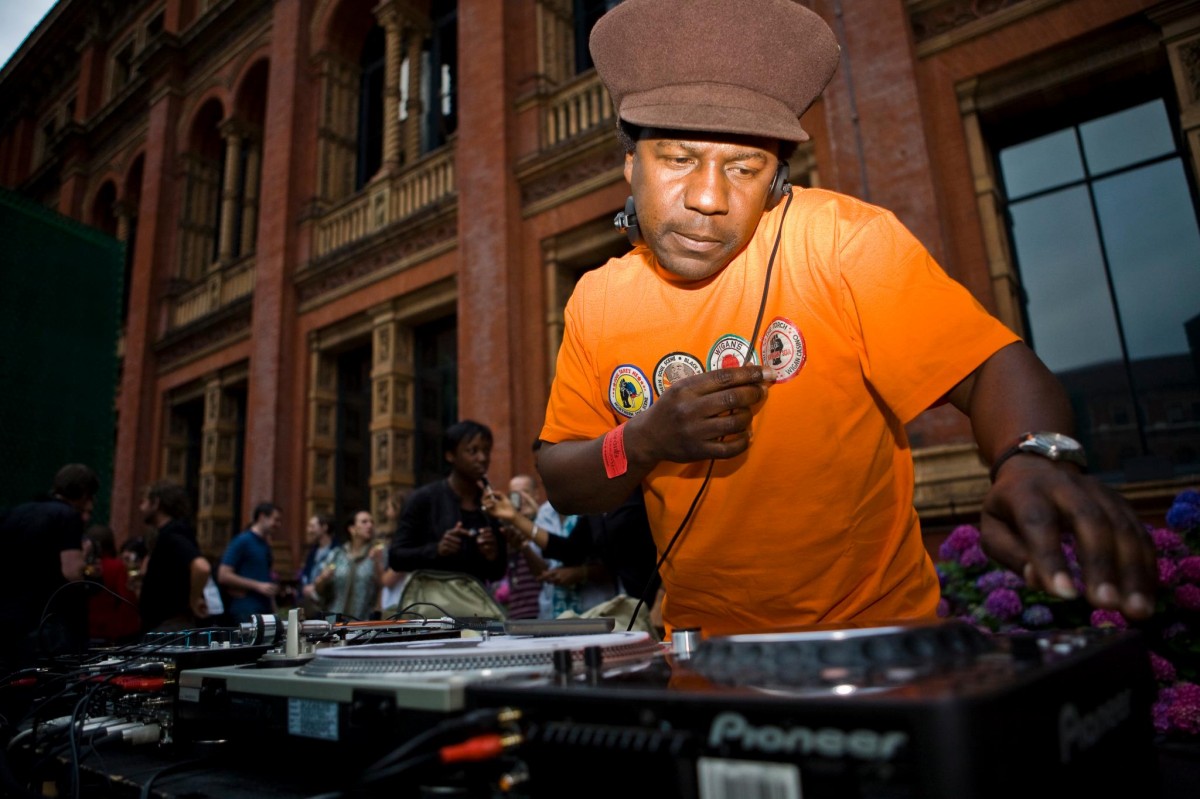
A class interview of Sir Norman Jay by Fabien Vouillon in New York City
Few figures have shaped British club culture as profoundly as Norman Jay. Born and raised in London’s Notting Hill, Jay emerged in the late 1970s as a pioneering selector whose open-minded approach to soul, funk, disco, and later house music helped define the UK’s “rare groove” movement. With his brother Joey, he founded the legendary Good Times Sound System, which became a cornerstone of the Notting Hill Carnival and introduced generations of dancers to a broader spectrum of Black music.
Beyond the streets of West London, Jay played a central role in the evolution of British dance music through pirate radio, club nights, and his work with Kiss FM in its formative years. His influence as a tastemaker and cultural ambassador was formally recognized in 2002, when he became the first DJ to receive an MBE for services to music.
This interview, conducted in New York City by French journalist Fabien Vouillon, brings Jay’s story full circle—back to the city whose block-party culture first inspired him and helped shape the transatlantic musical dialogue that would define his career.
Fabien Vouillon: So you’re going to Antigua next?
Norman Jay: Yeah, it’s called Back to Life Parties.
Q: And you’re only going to play once?
A: Yeah, because he does specially invited guests. He has David Rodigan in the UK—he’s the UK’s foremost reggae, dancehall, and old-school ska DJ. He’s brilliant. And they have Trevor Nelson there as well. He’s one of the leading rap and R&B DJs.
Q: So they have Trevor Nelson doing the big party, and you do the funky house and disco classics?
A: Exactly. I do the sort of funky house and disco classics. To me it’s all relative, and it always feels great to come here and play that music in New York. There’s something symbolic about it.
Q: Your website is very complete. Anyone interested in you can just go there. But what’s not on the website?
A: I don’t put certain corporate gigs in there because they’re private events—when I’m doing parties for pop stars or film stars or high-profile A-list people. Sometimes there may be a reference to it, but generally I keep it confidential.
Q: Your parents immigrated to the UK, right? From where in the West Indies?
A: Grenada—an island called Carriacou.
Q: How is it for the son of immigrants in London to become a Member of the British Empire?
A: No problem at all for me. I’m very proud. It’s the highest honor you can get. I think France has something similar.
Q: So someone else has to apply for you?
A: Yes. A petition goes through a long selection process, and then the Prime Minister presents a list to the Queen suggesting who should be honored.
Q: You said you’re still the only DJ in the world with an MBE.
A: It’s a very unique honor—yes.
Q: Which was more important: meeting the Queen or meeting James Brown?
A: One was a lifelong ambition and the other was a surprise. I’ll let you guess which is which. But I feel very fortunate. The world is full of DJs, especially in the UK, but I’m not trying to champion just one genre. I’m not a house DJ or a hip-hop DJ—I’m a party DJ.
Q: That’s what makes you unique.
A: I genuinely like most styles of music most of the time. I don’t profess to be all things to all people all the time, but most things to most people most of the time.
Q: You played some acid jazz classics yesterday, but also newer things. How do you feel about new genres?
A: I played some newer styles last night. I like a little bit of broken beat. I don’t really categorize music—I just like what I like, whether it’s new or old.
Q: Some people say DJs today are more selectors than anything else.
A: I’ve always been a selector. Whatever the genre, you take what you like and select it. People of my generation have always known that. I first played in this city in 1979, and in 2006 I’m still playing here. That says something.
Q: Your sound system started as a family organization?
A: Yes. When we started it was a family collective—both my brothers, my cousin, and local kids. It was like a hip-hop crew, a neighborhood thing. Every neighborhood had its own sound system. Today it’s more of a brand name—an umbrella for everything we do.
Q: In the UK you’re known mostly as a house DJ, but outside the UK you play everything.
A: Yes, in the UK maybe 95% I’m seen as a funky house DJ. But when I leave the UK, I play everything.
Q: Ten years ago in New York it was hard to find clubs playing mixed genres.
A: You have to remember it’s not just music—it’s business. In the 70s when discos started, DJs played all kinds of music. Then scenes became more single-genre. But now, with the iPod generation, it’s come full circle. People are used to hearing mixed music again.
Q: You still use vinyl and CDs. Do you use laptops or digital DJ systems?
A: I don’t need to. At the end of the day, it’s still entertainment. Nobody will pay to watch a DJ do what they can do in their bedroom.
Q: You’ve seen famous DJs just play a mix CD and leave the booth.
A: Yes, and they’re getting paid huge money. That’s short-term thinking. I’m in this for the long term. I still love it.
Q: You started Talking Loud with Gilles Peterson, but now you mostly DJ.
A: I’m a DJ. I might do one or two remixes a year, maybe some edits, but I’m not interested in selling records. I do those things for myself.
Q: You don’t release many compilations compared to other DJs.
A: That’s why mine still sell. You can flood the market. I do one compilation a year—they sell well, and I’m happy with that. Less is more.
Q: Your radio show allows you to play a wider range of music.
A: Yes. On radio I play a lot of 60s jazz, 60s R&B—music that doesn’t necessarily work in clubs.
Q: Do you come to New York often?
A: Not really. I’m very busy domestically in the UK. But I still have family here—in Queens and New Jersey.
Q: How did you like the club last night?
A: I loved it. It’s the one place I really wanted to play. Just the right size. I was very tired—I only got in at 7 a.m.—but I enjoyed it.
Q: You’ve embraced technology with your website and media work. Do you see live streaming becoming more important?
A: It’s already happening, but more technology doesn’t always mean people want more. If you give people too much choice, they spend more time choosing than enjoying. I’d rather give people one bottle of the best wine than ten bottles of bad wine.
Q: Why don’t you use visuals or cutting-edge tech in your sound system?
A: We’ve never tried to be cutting-edge technologically. We try to be accessible. Too much technology scares off girls—it attracts geeky boys. We’ve always played for a mixed crowd—men, women, gay, straight. Those are the best parties.
Q: So the best parties are mixed socially and musically?
A: Absolutely. Too much of one type of crowd—gender, orientation, or taste—makes parties feel wrong. I don’t do minority music anymore. I did that 25 years ago. I do fun music now—music for everyone.
Q: Many veteran DJs say they bring people in with familiar music and then educate them.
A: Life is always about compromise. You give people what they know, then you open their minds to something new.
Q: You’ve never been into drugs or alcohol.
A: No. I don’t drink, I don’t smoke, never done pills or cocaine. I don’t judge others—it’s a lifestyle choice. But drugs often make people enjoy themselves in isolation rather than together.
Q: How do you stay on top of music trends with such a busy schedule?
A: I don’t need to be the most cutting-edge. Anybody can download music. What matters is understanding people. You can’t get that just sitting in a room downloading tracks—you have to go out and feel the mood of the crowd.
Q: Do you still go record shopping?
A: Yes. I still buy new records. Going to stores lets you see people, feel the atmosphere, talk to fans. You can’t download that experience.
Q: Digital music has made everything more accessible. Is that a good thing?
A: It’s good, but it creates market saturation. The more you put out there, the less people are interested. Again—less is more.
Q: New York’s club scene has changed a lot.
A: Yes. Authorities, licensing, and rising rents have made it safer but more sterile. The danger and edge that once existed helped create culture, fashion, and new music scenes.
Q: Has New York lost its place as the world capital of dance music?
A: It lost that in the late 80s. London took over. The UK allowed pirate radio and youth culture to thrive—things that were never allowed here.
Q: Why do you still come back to New York?
A: Memories. For many years this was Mecca for music. There are still elements of that here. I’m never bored in New York.
Q: Did 9/11 change the city’s nightlife?
A: Definitely. The mood was very different afterward—joyless, subdued. I felt the same thing DJing in Australia after the tsunami. Big crowds, but emotionally muted. I don’t think New York has fully recovered yet.

Instagram: https://www.instagram.com/normanjaymbe


Leave a Reply